Description
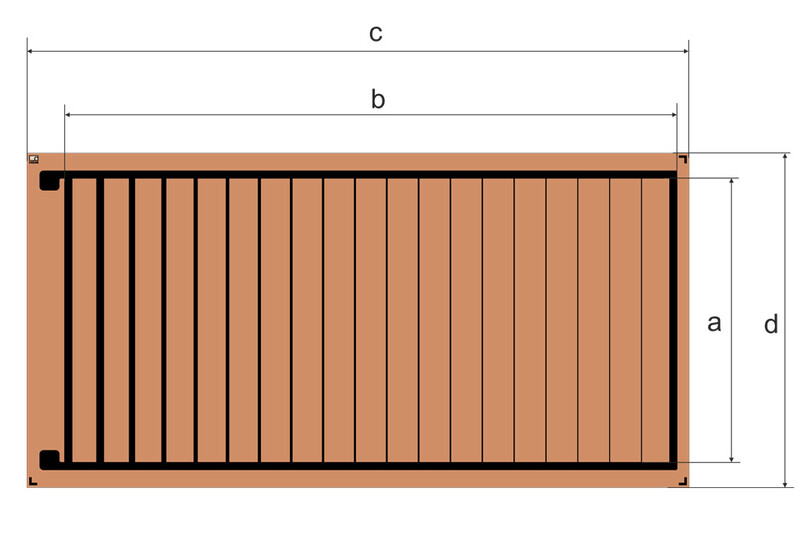
The RDS strain gauges are used to determine crack propagation in a component. HBK offers four different types:
- RDS20 and RDS40 consist of electrically isolated conductor tracks (resistors), i.e. as the crack extends, individual circuits will be interrupted. If the circuits are contacted individually, the direction in which the gap is extending can be detected. In this case, individual circuits are interrupted as the crack propagates.
- RDS17.8 and RDS22 consist of conductor tracks connected in parallel which will tear if the crack extends under the crack propagation gauge. This will gradually increase the electrical resistance of the strain gauge as the crack continues to extend.
This change in resistance can be measured using a resistance meter or strain gauge amplifier.
Connecting a crack propagation gauge and detecting signals
A resistance measurement can be used to detect the signal of the RDS crack propagation gauges. HBK DAQ systems can be used for this application (e.g. QuantumX or MGCplus).
The resulting resistance (R) of the RDS is dependent on the number of torn links and can easily be calculated. In this case, n identical resistors (Ri) are connected in parallel:
If a grid line is interrupted, this is described by
However, the measurement can be performed just as well with a measuring amplifier for SG measurements. The circuit diagram sketch shows how the RDS has to be complemented to obtain a resistance change that is inside the measuring range of an amplifier for strain gauge quarter bridges.
To minimize the effects of temperature, temperature-stable fixed resistors or SGs should be used as completion resistors. Greater sensitivity can be obtained by selecting a parallel resistor with a higher resistance value.